

 |  |  |  |  |
|---|---|---|---|---|
 |  |  |  |  |
 |  |  |
LAKE MACHINE
SYNOPSIS
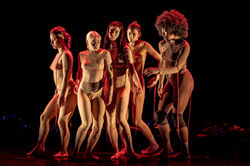
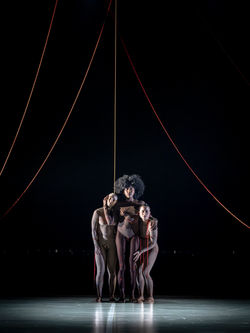
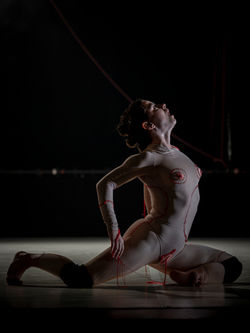
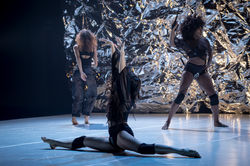
In LAKE MACHINE, Mari Paula resolutely and sensitively reinvents the classical universe to which women have been chained for centuries. Drawing from the tradition of ballet and theatre, the Brazilian choreographer based in Cantabria rescues three iconic figures—Odette and Odile from Swan Lake, and Ophelia from Hamlet—to free them from the roles of victims, madwomen, or martyrs to which they were condemned by the “boys” who wrote their stories.
The piece is a contemporary and visceral response to the classist, white, and patriarchal logic that has designed and shaped these works for more than 25 centuries. But LAKE MACHINE does not only rewrite the destiny of those characters; it also represents a deeply autobiographical act, in which the director confronts the mourning of her three stillborn daughters and transforms that intimate experience into a liberating choreography.
Here, madness is neither punishment nor fate, love is not sacrifice, death is not drama, and gender is a fluid territory. The music of Tchaikovsky and José Venditti enters into dialogue with the scene to open spaces where the female body and its multiple identities not only exist, but also claim presence and recognition.
LAKE MACHINE is a machine that beats with its own strength. It is vital humidity; it is that organic dimension that dismantles the machinery of structural power on stage and offers an emancipatory vision that addresses both performers and spectators alike. A piece that transforms classical tragedy into the light that the choreographer could not reach in her personal life.
They say it has a good ending.
TEAM
Idea, direction and choreography: Mari Paula
Performance: Araitz Lasa, Julia Kayser, Laura García Carrasco, Galina Rodríguez, Danielle Mesquita, Mari Paula and José Venditti. Cover: Rocío Barriga
Dramaturgical collaboration: Javier Cuevas
Music and sound design: José Venditti
Artistic mentoring: Poliana Lima
Assistant director: Lívia Delgado
Lighting design, technical direction and coordination: Carlos Molina and Nuria Henríquez
Set design: Marta Orta
Costume design: Sandra Espinosa
Textile art: Ana Muñoz de Terry
Photography: Áureo Gómez
Visual identity: Mutta Estudio
Premiere communication: Felisa Palacio
Community Manager: Talita Zuppo
Other perspectives: Carmen Larraz and Woody Santana
Video and teaser: Bandonthebend
Promotional teaser: Director: Álvaro Manof. Director of Photography: Ángel & Carlota. Music & Sound Design: Tchaikovsky & José Venditti. Editing: José Venditti. Color: Mucho Caviar
Sound production: Coro
Artistic and executive production: Sit and See (Iñaki Díez & Raquel Jiménez) and Mari Paula
Distribution: Sit and See (Iñaki Díez & Raquel Jiménez) & Micaela Trigo
Co-production
Mari Paula & Palacio de Festivales de Cantabria
ABOUT LAKE MACHINE
Ophelia, Shakespeare’s theatrical heroine, who is born already dead, like Juliet, Cordelia, or Desdemona, because only her madness and her death give her meaning in the patriarchal universe in which they were created.
Odette and Odile, who are born, like Giselle, dead in that perverse tale that would give rise to the most celebrated and applauded ballet in the history of classical dance, Swan Lake, because only their pain and their death can find a place in stories created by and for strictly male gazes.
But Ophelia, Odette, and Odile, the daughters of Mari Paula, who are born dead, who generate voids, silences, and extreme pain, and who now, with the absolute premiere of LAKE MACHINE, need to become dance in order to heal memory and dream of another ending.
In a very schematic way, that is LAKE MACHINE, but it is also a risky, exposed choreographic and personal commitment that lays bare emotions and grievances, and that seeks to return the Odettes, Odiles, and Ophelias of cultural history and of life itself to the stage, in order to weave a complaint, a rebellion, a different role, and a diverse ending.
A large-scale commitment that appears as a logical evolution from the pieces and projects we already knew by Mari Paula—from the seriousness and rigor of her work, from her awareness of the body, movement, and art as vehicles for storytelling and transgression.
(Regino Mateo Pardo, 2025)
MY LOVE LETTER TO THE PIECE
Hello. I am Mari Paula, the director of this piece. And I wrote this piece to understand why I am so deeply in love with ballet and classical theatre, and also to give a new opportunity to the characters who have been imprisoned by drama for 25 centuries.
They are Electra, Medea, Antigone, Juliet, Giselle, Desdemona, Ophelia, Odile, and Odette, and it is on the last three that I will focus.
Ophelia, Odile, and Odette are three women trapped in a personal drama, designed and laid out by a boy author, within a classist, white, and virile logic.
Ophelia, Odile, and Odette are also my three daughters, who were born already dead. Yes, I gave birth to three stillborn daughters, and I came to know the purest love together with the most devastating void that can exist.
Ophelia, in her theatrical life, has had two opportunities to live, yet she was also born dead. When Shakespeare brings Hamlet to life, he condemns Ophelia to madness and death. When Heiner Müller writes his Hamlet Machine, he also gives birth to Ophelia dead.
And every time a director restages Hamlet, she is born dead again.
In my personal drama, my daughter Ophelia had a tragic destiny. But in my fictional drama, Ophelia will be free and the owner of her own destiny, because this story is written by me—without science, without dogmas, and without boys.
I also want to speak to you about my other two daughters, Odile and Odette, whom, like Ophelia, I will free in this work. I will remove them from the decadent libretto of Swan Lake, where they have been condemned to be enemies and victims of betrayals orchestrated by a sorcerer boy and by a prince who needs to get married.
Have you noticed that in the history of the classics women are always mad, whores, dying of love, murdered, or committing suicide? And all because of a boy? Moreover, a boy whom, if we remove him from the choreographic structure, we do not miss. It is we who bring color, life, and soul to these classics.
We, women and classical and contemporary dancers. Classical and contemporary housewives. Classical and contemporary workers, have spent the entire history of humanity providing choreographic support to sustain the whim of the great BIG BOY.
So, for this piece, I steal Ophelia from Hamlet, I steal Odette and Odile from Swan Lake, and I also steal all the women whom drama does not represent.
I invite them to inhabit a contemporary body, with whatever gender they choose, with the freedom to fall in love with whomever they please, and not to die of love or for love, but to be free to trace their own destiny.
Tchaikovsky enters.